Lorem ipsum dolor sit amet, consectetuer adipiscing elit.
Back
END ≤30 m as a Standard: What It Means in Practice for Gas Selection
05/19/2026
Technical divers love precision. We calculate decompression schedules down to the minute, obsess over gas reserves, and debate ppO₂ limits endlessly. But when it comes to narcosis management, many dives could be made dramatically safer with one simple standard:
Equivalent Narcotic Depth (END) ≤30 m.
That single rule instantly simplifies gas selection, improves team consistency, and reduces the risk of poor decisions at depth. Whether you dive open circuit trimix or CCR, END ≤30 m is one of the easiest ways to stay mentally sharp when conditions become demanding.
In this guide, we’ll explain:
- What END actually means in practice
- How to use END ≤30 m as a fast gas-selection workflow
- Why standardized gases make team diving safer
- What changes (and what doesn’t) on CCR
- Why END alone is not enough
- A downloadable “Quick Gas Cards” system you can save to your phone or print for dive planning
What END ≤30 m Actually Means
Equivalent Narcotic Depth estimates how narcotic your breathing gas feels compared to breathing air at a shallower depth.
In many technical diving standards:
- Helium is treated as non-narcotic
- Oxygen and nitrogen are treated as narcotic
- END becomes a simple way to estimate cognitive performance underwater The idea behind the 30 m guideline is practical, not magical. At roughly the narcotic effect of air at 30 meters, most trained divers can still:
- Process information effectively
- Handle unexpected problems
- Navigate and communicate reliably
- Maintain better situational awareness
Below that threshold, mistakes become far less likely. Above it, performance degradation accelerates quickly — especially when stress, darkness, current, cold, or task loading enter the equation.
And that’s where many divers get caught.
A Real Lesson From 57 Meters
Years ago, we did a dive on a flooded church at 57 meters using air and open circuit.
At the time, we genuinely believed it was acceptable.
The diving community around us had a similar mindset, and because we considered ourselves “technical divers,” we convinced ourselves that recreational depth limits simply didn’t apply to us.
The descent line was tied to the church tower.
Visibility was around 3 meters. Absolute darkness.
To return to the ascent line, we had to follow the tops of the church walls back toward the tower. When it was time to leave, we reached the wall and swam in what we believed was the correct direction.
Instead of the tower, we hit the roof ridge.
“That’s strange,” we thought. “The tower must be on the opposite side.”
We turned around and swam the other way.
Again — roof ridge.
Back again.
Same thing.
Only after several frustrating minutes did it finally click:
We were inside the section of the church behind the roof ridge — where no tower existed at all. We first needed to cross around the roof structure before reaching the correct wall leading back to the ascent line.
Eventually we found the line, but significantly later than planned.
Fortunately, we had a robust reserve strategy and enough gas to handle the delay safely.
But the real lesson came afterward.
With a clear head, the problem was trivial. Under normal cognitive performance, we would probably have known exactly where we were the entire time. Even if we had initially made the wrong turn, the situation should have become obvious immediately after the first encounter with the roof ridge.
Instead, narcosis dramatically slowed our ability to interpret and solve a simple spatial problem.
The conclusion became unavoidable:
Air has no place at those depths.
And every additional stressor — darkness, cold, low visibility, restrictions, current — demands an even more conservative approach.
Over the years, repeated experience has reinforced the same lesson:
- END values above 30 m carry substantial risk
- Closed environments magnify narcosis dramatically
- Deep dives punish slow thinking That experience fundamentally changed how we plan dives today.
The END ≤30 m Workflow for Gas Selection
One reason divers adopt END ≤30 m is because it simplifies planning enormously.
Instead of endlessly optimizing mixes, you can use a repeatable workflow.
Step 1: Calculate the Oxygen Fraction (FO2)
Start with:
- Planned maximum depth (for example 60 m) and convert it to absolute pressure “P”. The absolute pressure is the depth / 10+1 so in our case 60 / 10+1 = 7)
Working PO₂ target for bottom
o Commonly 1.2 –1.3 bar
o Often lower for long or demanding dives
FO2 = PO2 / P
FO2 = 1.3 / 7 (everybody knows that the absolute pressure is the (depth / 10)+1 so in our case (60 / 10)+1 = 7)
FO2 = 0.18
When we multiply the fraction by 100, we get the percentage of oxygen in the mixture. In our case, that is 18%.
Step 2: Calculate the Helium You Need
You'll be at a depth of 60 meters, but you want to experience no more narcotic effects than you would at 30 meters.
Your helium fraction is what primarily controls END.
Determine maximum nitrogen percentage for the planned maximum depth
Partial pressure of nitrogen at 30 m is 3,12 bar (4 x 0,78)
Calculate Fraction of Nitrogen (FN2) for the maximum depth:
FN2 = 3,12 / P
FN2 = 3,12 / 7
FN2 = 0,445… (we can round it to 0.45) it This corresponds to 45% nitrogen in the mixture.
We already know that we need 18% oxygen and a maximum of 45% nitrogen.
We have to make up the rest with helium (100 - 18 + 45 = 37).
So we need a mixture of 18/37
As depth increases you need more helium
Practical Tip for Divesoft Users
In Divesoft.app, you can:
- Calculate the optimal gas mixture for a given depth, taking into account END, PO₂, and density (Starting with firmware version 2.7.0)
- Get a recipe for how to prepare this mixture by filling or transferring (Starting with firmware version 2.7.0)
- Set END warning thresholds
- Configure END targets
- Choose whether oxygen is considered narcotic in calculations
Step 3: Choose the Nearest Standard Mix
This is where experienced teams avoid unnecessary complexity.
Instead of custom-tuning every dive:
- Pick standard gases
- Use familiar MODs
- Keep predictable END values
- Simplify bailout planning
- Improve team compatibility
Consistency beats micro-optimization.
That makes it much easier to standardize planning across teams and dives.
| Depth Range | Typical Standard Gas Example | Common Use | Notes |
|---|---|---|---|
| 0–30 m | Air / Nitrox | Recreational & shallow tech | END not usually limiting |
| 30–45 m | Trimix 21/35 | Normoxic trimix | Reduced narcosis, manageable logistics |
| 45–60 m | Trimix 18/45 | Deep OC / CCR diluent | Common “serious trimix” range |
| 60–75 m | Trimix 15/55 | Advanced deep dives | Hypoxic at surface |
| 75–90 m | Trimix 12/65 | Expedition/deeper tech | Strict protocols required |
Why Technical Teams Standardize Gases
Most experienced expedition or training teams eventually converge toward standard gas sets.
Why?
Because standardized gases simplify:
- Team communication
- Gas logistics
- Labeling
- Analysis
- Bailout compatibility
- Emergency procedures
Many commonly used trimix standards are built around two principles:
- Working PO₂ around 1.2–1.3
- END ≤30 m
That applies both to:
- OC bottom gas
- CCR diluent strategies
No single table is universal, and divers should always follow their agency training and team SOPs. But standardized approaches dramatically reduce planning errors.
As one experienced cave instructor once put it:
“Complexity is seductive underwater. Standardization is what keeps teams alive.”
OC vs CCR: What Changes — and What Doesn’t
Many divers assume CCR somehow eliminates narcosis concerns.
It doesn’t.
Oxygen setpoint changes loop composition dynamically The maximum PO₂ in the cylinder differs from the setpoint (the desired PO₂ in the loop) because the mixture in the loop must remain dilutable even at maximum depth.
Diluent composition drives inert gas exposure
Bailout gases must still match the dive plan
What Does NOT Change
END is still a critical planning tool.
Your loop gas composition still determines:
- Narcosis exposure
- Cognitive performance
- Mental workload tolerance
If your diluent is overly narcotic, your brain still experiences the consequences.
END Is Not the Only Limiter
This is important:
A gas can meet END ≤30 m and still be unsafe.
Why?
Because gas density and work of breathing may become the bigger problem.
High-density gas can:
- Increase CO₂ retention
- Raise breathing resistance
- Increase panic risk
- Contribute to CCR failures
Especially in:
- Cold water
- Strong current
- Restriction diving
- High workload situations
END is an excellent default standard.
But it should always be combined with:
- Gas density checks
- Conservative workload assumptions
- Realistic emergency planning
Interestingly, gas mixes planned around the commonly recommended 5.2 g/l density limit usually contain considerably more helium than mixes selected only by END ≤30 m. In practice, divers following density limits rarely struggle with severe narcosis.
Quick Gas Cards (Recommended Download)
To make planning faster and more consistent, create a simple set of “Quick Gas Cards” for your team.
Card 1 — END ≤30 m Workflow
- Maximum depth
- Oxygen percentage
- END target
- Helium calculation
- Standard mix selection
Card 2 — Standard Mix Table
- Metric depth bands
- Common trimix examples
- MOD reminders
- Hypoxic warnings
Card 3 — CCR Reminders
- Diluent PO2 check
- Diluent END check
- Bailout alignment
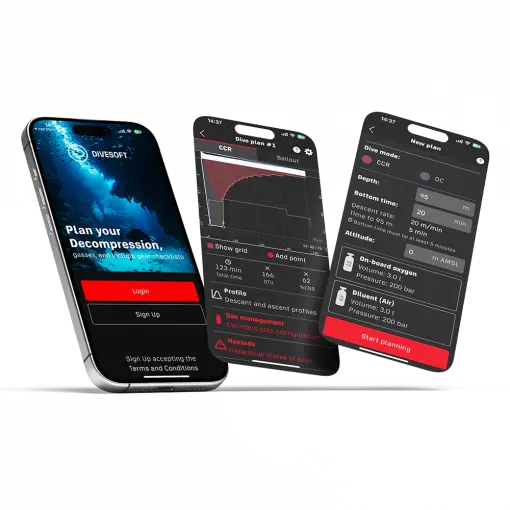
Divesoft.app
Plan your decompression, gasses, utilize checklists, check your logs + more!!
All for Free.
People You Can Rely On.
Gear You Can Trust.