PO₂ Limits 1.4 / 1.6: When to Use Which and Why
05/26/2026
Is 1.6 PO₂ safe? Should you always stay below 1.4? And why do so many experienced divers still use both limits depending on the dive phase?
If you’ve ever felt confused by conflicting advice around oxygen exposure limits, you’re not alone. Recreational nitrox divers, technical divers, and CCR users often hear the same numbers repeated — but not always explained clearly. The good news? The practical rule set is actually pretty simple.
In this article, we’ll break down:
- why 1.4 ATA is commonly used as a working limit
- when 1.6 ATA may be acceptable
- how CNS% and OTU tracking really work
- and how to use a simple PO₂ exposure calculator to make repeatable, defensible dive plans
Whether you dive nitrox recreationally or run a CCR with variable setpoints, the goal is the same: manage oxygen exposure intentionally instead of guessing.
What PO₂ Actually Controls
PO₂ (partial pressure of oxygen) is the amount of oxygen pressure your body experiences at depth.
Why does it matter?
Because as PO₂ rises, so does the risk of acute CNS oxygen toxicity — the type associated with convulsions underwater. The formula itself is simple:
PO2 = FO2 x Pabs
Where:
- FO₂ = oxygen fraction in the gas
- Pabs = absolute pressure at depth For example:
- EAN32 at 30 m / 100 ft
- Absolute pressure ≈ 4 ATA
- PO₂ = 0.32 × 4 = 1.28 ATA
That’s comfortably within common recreational nitrox limits.
But increase either:
- oxygen fraction
- or depth
…and PO₂ climbs quickly.
That’s why nitrox planning is really oxygen exposure planning.
The Practical Standard: 1.4 for Diving, 1.6 for Controlled Decompression
Here’s the simplified rule most divers eventually settle on:
Dive Phase Common PO₂ Limit
Working / active phase 1.4 ATA
Controlled decompression 1.6 ATA
This isn’t random tradition. It’s about risk margin.
Why 1.4 Became the “Working Limit”
During the active phase of a dive, divers may experience:
- increased workload,
- elevated CO₂ retention,
- stress,
- cold exposure,
- poor visibility,
- current,
- elevated breathing resistance,
higher gas density.
And CO₂ is a major factor here.
High CO₂ levels are believed to significantly increase susceptibility to CNS oxygen toxicity. In real-world diving, you usually can’t perfectly predict exertion levels underwater — so divers build in margin.
That margin is commonly:
- 1.4 ATA for open circuit
- and often 1.2–1.3 ATA CCR setpoints during deeper working phases.
But it always depends on how long you've been exposed to that partial pressure
SCUBA divers are exposed to maximum PO₂ only at maximum depth, or at maximum depth with each gas mixture. CCR divers are constantly exposed to the same PO₂
Why 1.6 Is Still Used
Now compare that to a typical decompression stop:
- shallow water,
- stable buoyancy,
- lower gas density,
- minimal exertion,
relatively short exposure windows.
That’s a much more controlled environment can be operationally efficient while still remaining within commonly accepted exposure frameworks.
The key point:
1.6 ATA is generally treated as a controlled exposure limit — not a default operating target for all phases of the dive. That distinction matters.
NOAA Exposure Limits: CNS% and the Oxygen Clock
Most modern dive computers track oxygen exposure using NOAA-style limits. You’ll usually see this displayed as:
- CNS%
- oxygen clock
oxygen exposure
They all refer to the same basic concept: how much of your recommended oxygen exposure you’ve used.
The Two Things Divers Track
1. CNS% (Central Nervous System Exposure)
This tracks short-term exposure associated with acute oxygen toxicity risk. Higher PO₂ = faster CNS accumulation.
Example anchors from NOAA-style exposure tables:
PO₂ Approx. Single Exposure Limit
1.4 ATA 150 minutes
1.5 ATA 120 minutes
1.6 ATA 45 minutes
That’s why:
- 1.6 can work for short deco windows,
- but becomes dangerous for long bottom phases.
2. OTU (Oxygen Tolerance Units)
OTU tracks longer-term pulmonary oxygen exposure. For many recreational nitrox dives, OTU is less important.
But it becomes highly relevant during:
- long CCR decompression,
- repetitive technical diving,
- expedition diving,
multi-day exposure accumulation.
This is why serious dive planning should track:
- PO₂,
- CNS,
and OTU together.
Modern dive computers — including advanced technical and CCR systems — typically automate this process in real time.
What Increases Oxygen Toxicity Risk?
This is where many simplified internet discussions become misleading.
PO₂ alone does not tell the whole story.
Several factors may increase oxygen toxicity susceptibility:
- elevated CO₂ retention
- hard work / high exertion
- cold stress
- dehydration
- fatigue
- poor ventilation
- elevated gas density
long exposure durations
That’s why two divers can experience the same PO₂ very differently depending on conditions.
Practical Rule
The more stressful the dive becomes:
- the more conservative your PO₂ planning should be. That’s also why many technical teams standardize conservative operating procedures instead of chasing theoretical maximums.
What New Research Is — and Isn’t — Saying
In 2025, a NOAA-supported expert workshop revisited one of the biggest questions in modern CCR diving:
Are traditional CNS oxygen exposure limits too conservative for commonly used CCR setpoints around PO₂ 1.3?
The discussion was driven by a simple reality:
modern CCR dives frequently exceed older NOAA oxygen exposure tables — especially during long decompression phases — yet reported CNS oxygen toxicity incidents remain relatively rare.
A recent publication in *Diving and Hyperbaric Medicine Journal
- reviewed available evidence specifically for:
- constant PO₂ rebreather diving,
- at a PO₂ of 1.3 ATA,
which remains one of the most common default CCR setpoints.
The updated recommendation concluded that dives consisting of:
- up to 240 minutes of working dive time
- followed by up to 240 minutes of resting decompression
- at PO₂ 1.3 ATA appear to carry an acceptably low risk of CNS oxygen toxicity under controlled conditions. That effectively means:
- roughly 8 total hours
- at a PO₂ of 1.3 ATA
- within the revised guidance framework.
Why This Matters for CCR Divers
This is highly relevant because:
- PO₂ 1.3 is widely used as a default CCR setpoint,
- especially during long technical dives,
- exploration dives,
- and extended decompression profiles.
The revised guidance also reflects something many experienced CCR divers already observed operationally:
modern technical dives often exceeded older NOAA tables without a corresponding rise in CNS toxicity events.
But This Is NOT “Permission to Run Higher PO₂ Everywhere”
The nuance matters.
The updated recommendation applies specifically to:
- PO₂ 1.3,
- under controlled CCR conditions,
- with available supporting evidence. It does not automatically justify:
- increasing working PO₂ toward 1.4–1.6,
- ignoring CNS tracking,
or treating oxygen toxicity risk as “solved.”
The same paper also emphasizes that:
- individual susceptibility varies,
- CO₂ retention remains a major concern,
and evidence for higher operational PO₂ ranges is still limited.
So for most divers, the practical takeaway remains conservative and simple:
- use reasonable working setpoints,
- reserve higher PO₂ exposure for controlled decompression,
- and always monitor CNS and OTU exposure throughout the dive.
Quick Decision Rules
If you want a practical takeaway, here it is.
Use More Conservative PO₂ When:
- workload is high
- diving is cold or stressful
- gas density is elevated
- visibility or conditions are poor
- exposure duration is long
CO₂ retention risk increases
1.6 ATA Is Most Commonly Used When:
- shallow
- stable
- controlled
- low exertion
- short exposure duration
- decompression-focused Always Track:
- PO₂
- CNS%
OTU (especially for CCR or repetitive technical diving)
Consistency matters more than internet debates.
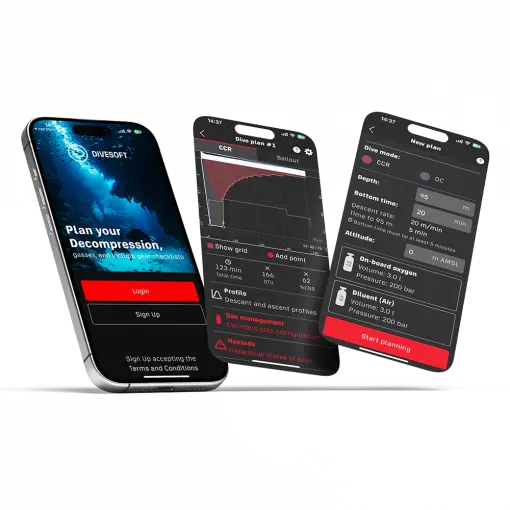
Use the Divesoft.app Instead of Guessing
The easiest way to remove uncertainty from oxygen planning is simple: Use the Gasblend and Planner calculators. A good workflow should allow you to:
- enter gas mixes,
- define depth segments,
- calculate PO₂,
- track CNS accumulation,
- monitor OTU exposure,
and review your overall oxygen loading before the dive.
This is especially useful for:
- technical dive planning,
- gas switching,
- CCR decompression,
- expedition diving,
and repetitive nitrox exposure.
Recommended Workflow
- Plan gases and MODs
- Set operational PO₂ limits by dive phase
- Review CNS% and OTU projections
- Set computer alarms appropriately
- Monitor exposure during the dive
The goal isn’t to chase maximum limits. The goal is to maintain predictable safety margins while still running efficient dives.
Final Takeaway
The 1.4 vs 1.6 discussion is less about “right vs wrong” and more about matching PO₂ to the operational context.
The simplified version:
- 1.4 ATA → common working limit
- 1.6 ATA → controlled decompression exposure limit
- 1.3 ATA → common CCR setpoint
That framework has remained popular for a reason: it balances efficiency with practical real-world safety margins. And regardless of what limits your team or training agency uses, the most important habit is this:
Don’t just plan depth. Plan oxygen exposure.
Divesoft.app
Plan your decompression, gasses, utilize checklists, check your logs + more!!
All for Free.