Why Underwater Photographers Use Rebreathers
Underwater photographers use rebreathers because they reduce bubbles and noise, allow longer observation time, and help divers become a quieter presence around marine life. Underwater photography is often associated with cameras, strobes, and lenses. But experienced photographers know that equipment is only part of the equation.
Patience matters. Observation matters. And sometimes the difference between getting a photograph and missing it comes down to a few extra minutes in the right place at the right time. That is one reason many underwater photographers choose rebreathers.
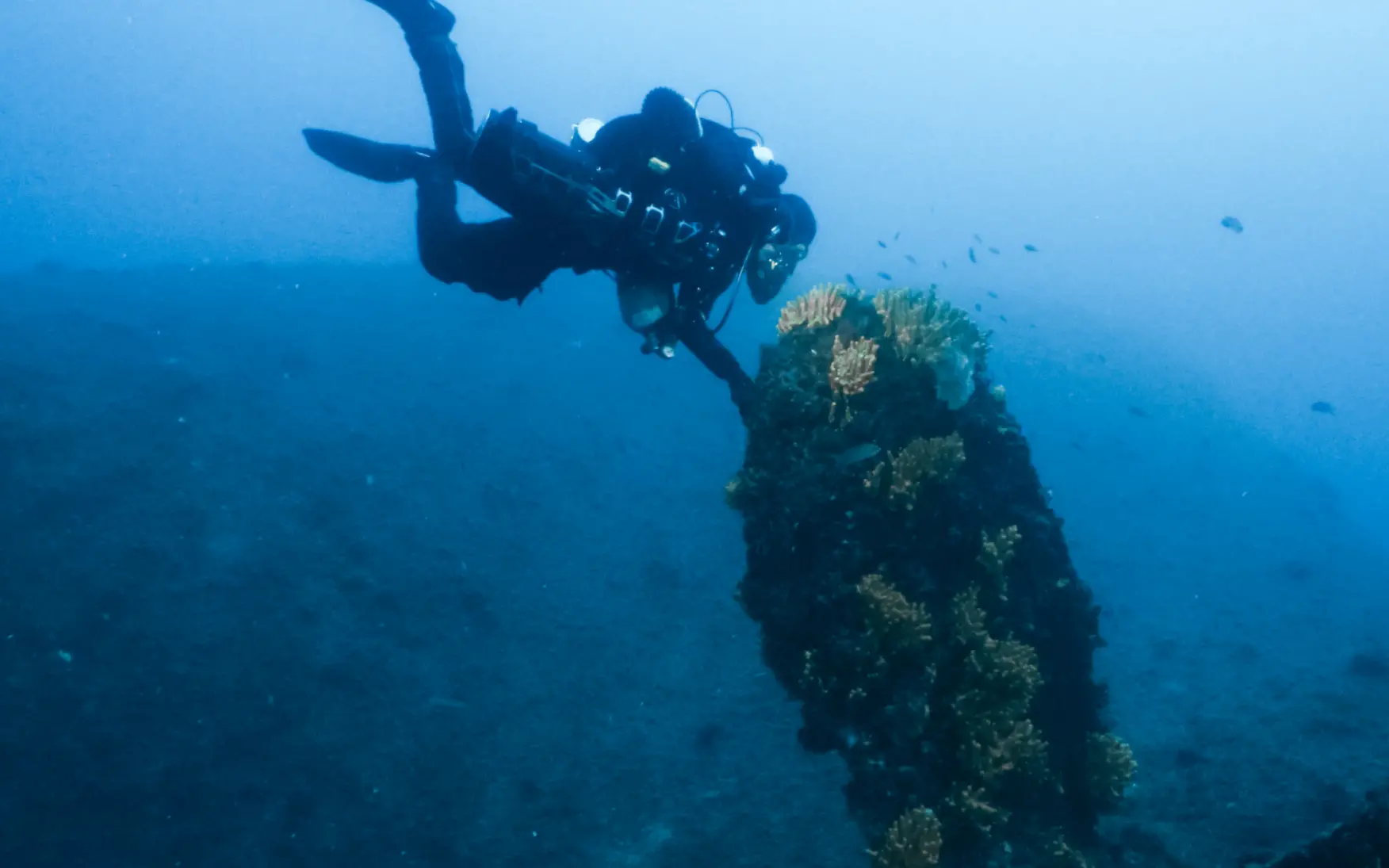
Main reasons photographers use rebreathers:
- fewer bubbles,
- quieter underwater presence,
- longer observation time,
- less disturbance to marine life,
- more natural animal behaviour,
- more opportunities for the right shot.
Closer to Marine Life
One of the most obvious differences between open-circuit scuba and a rebreather is what happens when the diver exhales. With open-circuit scuba, every breath is released into the water as bubbles. A rebreather returns the exhaled gas to the breathing loop, removes carbon dioxide, and reuses the remaining gas.
The result is a much quieter underwater presence. Marine life does not always react the same way to divers. Some animals seem completely indifferent. Others keep their distance.
Many photographers and wildlife observers notice that certain species appear more relaxed around divers who are not producing a constant stream of bubbles. This does not mean animals will automatically approach a rebreather diver. Nature rarely follows simple rules. But it is one of the reasons photographers often become interested in CCR diving.
When Marine Life Forgets You Are There
Photographers often talk about getting closer to marine life when using a rebreather. Sometimes the difference is surprisingly obvious. While diving on a CCR in the Red Sea, I have repeatedly experienced fish approaching far more closely than they typically would around open-circuit divers.
On several occasions, a bird wrasse became so comfortable with my presence that it swam directly in front of my mask. During one dive, I turned around to check where my buddy was and was startled to find the fish hovering only a few centimetres from my face, calmly inspecting me. Another diver experienced something similar with a batfish. The fish stayed so close for so long that it almost seemed to mistake the diver for another large marine animal rather than a human visitor.
Experiences like these are difficult to guarantee and impossible to schedule. Wildlife never follows a script. Yet many CCR divers report similar encounters. Without the continuous noise and disturbance created by exhaust bubbles, some animals appear noticeably more willing to approach and continue their normal behaviour.
Cleaning stations provide another fascinating example. During decompression stops, rebreather divers sometimes become part of the attraction. Small cleaner wrasses may begin picking at exposed skin around the face and neck, treating the diver much like any other large creature visiting the reef. For wildlife photographers, these moments can be extraordinary.
The goal is not simply to get closer to animals. The goal is to witness behaviour that often disappears when marine life becomes aware of a diver's presence. That is where a rebreather can offer something genuinely different from open-circuit scuba.
Less Noise, More Observation
Most divers stop noticing their own bubbles after a while. The sound simply becomes part of the background.
A rebreather changes that. Without the constant noise of exhaled bubbles, many photographers describe the dive as feeling calmer and less intrusive.
The underwater environment often feels different. Not because the reef changes. Not because the animals change. Because the diver becomes a quieter visitor.
For photographers who spend long periods observing behaviour before taking a picture, that difference can be surprisingly noticeable.
Sometimes the Best Shot Comes 20 Minutes Later
One of the biggest misconceptions about underwater photography is that great images happen quickly. Often, the opposite is true.
A photographer may spend twenty minutes observing a cleaning station before the right fish arrives. A turtle may disappear behind a reef and return only after several minutes. A school of fish may repeatedly circle a wreck before finally moving into the perfect position. The photograph itself may take only a fraction of a second. The waiting can take much longer.
This is where the efficiency of a rebreather becomes valuable. The additional time is not simply spent underwater. It is spent observing, waiting, and allowing opportunities to develop naturally. Many photographers discover that their best images are not captured during the first ten minutes at a site.
They are captured twenty or thirty minutes later, after most divers would already be thinking about gas reserves and the ascent.
The Dive Becomes the Blind
Wildlife photographers on land often spend hours sitting quietly in hides, waiting for animals to behave naturally. Many underwater photographers describe rebreather diving in a similar way. Without the constant stream of bubbles, the diver becomes less noticeable.
The objective is not to approach animals aggressively. The objective is to spend enough time in one place that marine life becomes comfortable continuing its normal behaviour. Some of the most interesting photographs happen when the diver stops chasing the subject and simply waits.
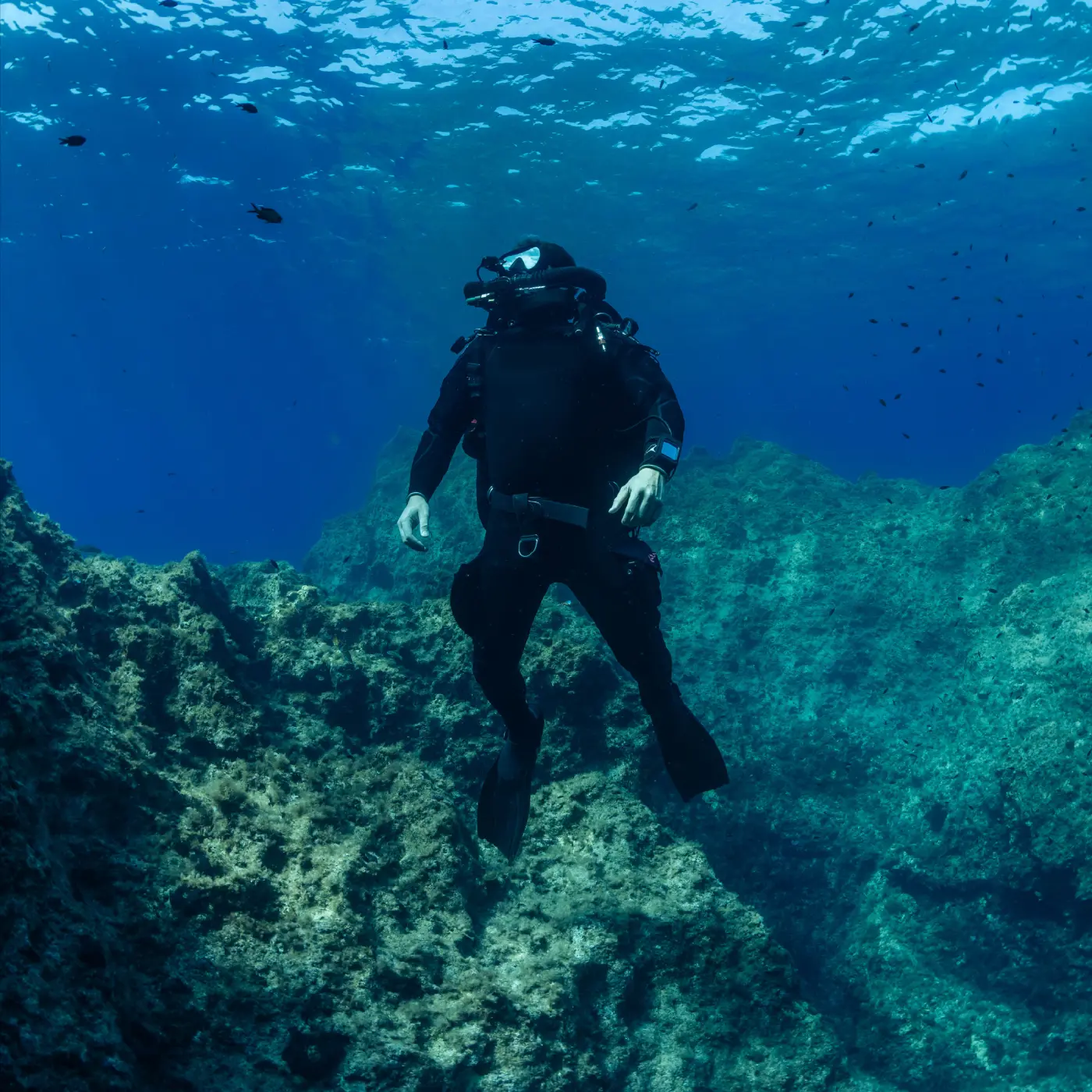
Not Just for Professional Photographers
You do not need to work for a magazine or carry a professional camera system to appreciate these advantages. Many recreational divers discover the value of a rebreather with nothing more than a compact camera or action camera.
The principles remain the same.
- More time.
- Less noise.
- Fewer bubbles.
- More opportunities to observe what is happening underwater.
The camera simply gives the diver a reason to stay and watch.
Photography Is About Opportunity
Good underwater photographs rarely happen on command. They happen when preparation, timing, conditions, and a little luck come together.
A rebreather does not replace skill. It does not guarantee better photographs. What it can do is create more opportunities for those moments to happen.
For many photographers, the greatest advantage is not simply staying underwater longer. It is becoming a quieter part of the underwater environment and having enough time to watch events unfold naturally.
That is why rebreathers have become popular not only with photographers, but also with filmmakers, researchers, and anyone who spends time observing life underwater.
Curious About Rebreather Diving?
Learn how rebreathers work, how they differ from open-circuit scuba, and why different divers choose them for different reasons.
> What Is a Rebreather and How Does It Work?
> Why Do Divers Use Rebreathers?
FAQ
- Why do underwater photographers use rebreathers?
Many underwater photographers choose rebreathers (CCRs) because they produce fewer bubbles, create less noise, and often allow longer observation times. These advantages can make underwater photography more enjoyable.
- Do rebreathers help divers get closer to marine life?
They can. With fewer bubbles and less noise, a rebreather (CCR) may reduce disturbance, allowing divers to observe marine life behaving more naturally.
- Are rebreathers quieter than open-circuit scuba?
Yes. Unlike open-circuit scuba, a closed-circuit rebreather (CCR) recycles breathing gas instead of releasing every breath as bubbles, creating a noticeably quieter underwater presence.
- Do rebreathers improve underwater photography?
A rebreather (CCR) can create better opportunities for underwater photography by reducing disturbance and allowing more time with the subject. The quality of the photographs still depends on the photographer's skill, conditions, and equipment.
- Are rebreathers useful for wildlife filming?
Yes. Many underwater filmmakers use rebreathers (CCRs) because quieter dives and fewer bubbles can help them spend more time observing and filming natural animal behaviour.
- Can recreational photographers use rebreathers?
Yes. Recreational divers who are trained to use a rebreather (CCR) can enjoy the same benefits, including quieter dives, longer observation times, and fewer bubbles.
- Do rebreathers guarantee better wildlife encounters?
No. A rebreather (CCR) can reduce disturbance, but it cannot guarantee closer encounters or predictable animal behaviour. Every wildlife encounter depends on the species, the environment, and the diver's behaviour.
- Why are fewer bubbles useful for underwater photography?
Fewer bubbles create less noise and visual disturbance, helping photographers observe marine life in a more natural way and spend more time waiting for the right moment.
Author: Divesoft