How Long Can You Stay Underwater With a Rebreather?
One of the most common questions about rebreathers is also one of the hardest to answer: How long can you stay underwater?
Unlike open-circuit scuba, where cylinder pressure often determines when the dive ends, a rebreather introduces several other factors. Oxygen supply matters. So does scrubber duration. Water temperature, workload, decompression requirements, and dive planning all play a role. That is why experienced CCR divers rarely answer this question with a single number.
A CCR rebreather can often support dives lasting one to several hours, but the real limit is usually scrubber duration, bailout gas, decompression obligations and dive conditions — not oxygen alone.
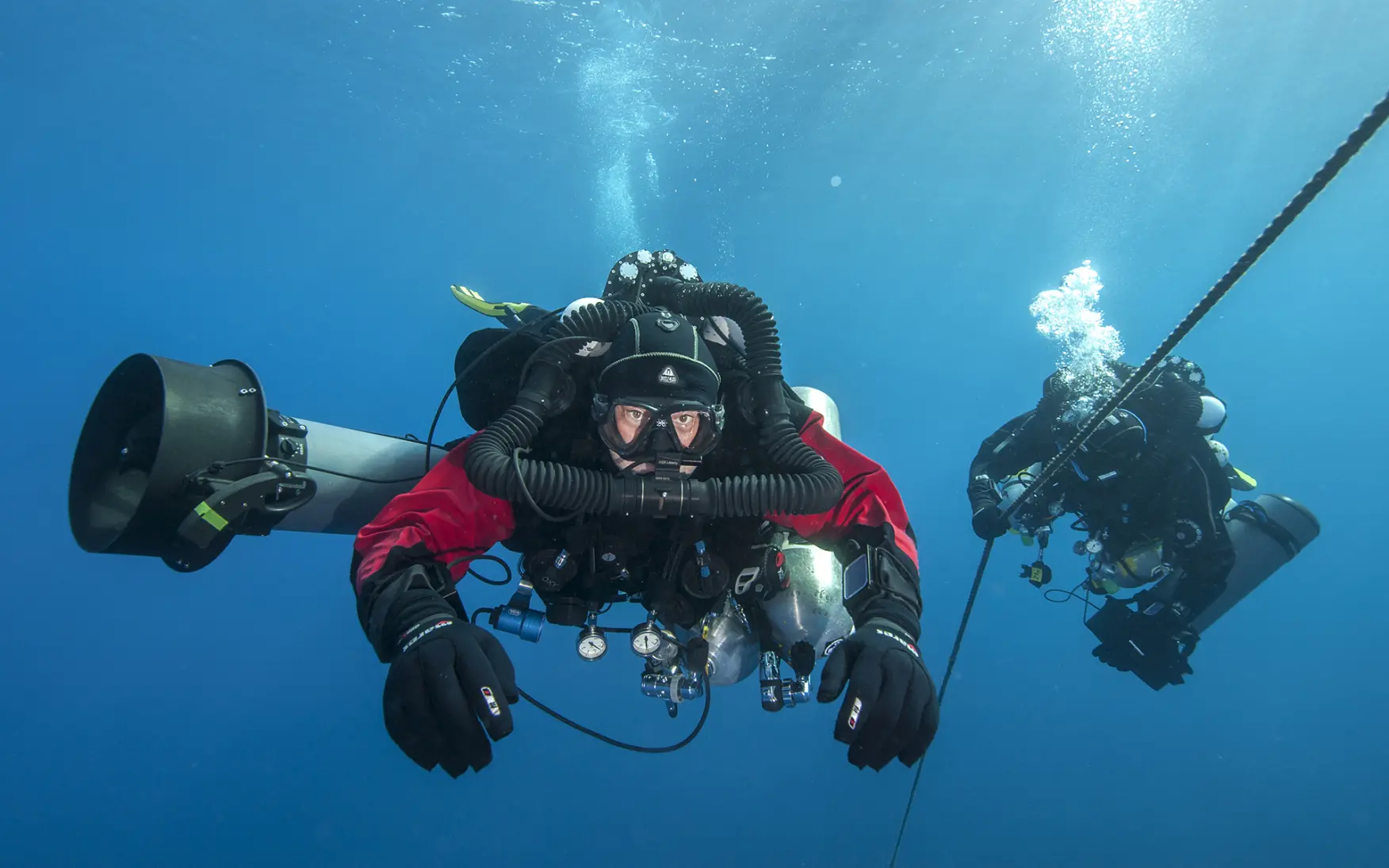
In Practice, the Answer Is Often Surprisingly Simple
At first glance, determining how long a diver can stay underwater with a rebreather appears complicated.
In reality, it is often easier than planning the same dive on open circuit. Most experienced CCR divers begin with three simple questions:
How much oxygen is available?
How long is the scrubber rated for?
What does the bailout plan require?
The oxygen calculation is usually straightforward. A diver knows how much oxygen is in the onboard cylinder and can estimate consumption using a conservative metabolic rate. Many divers simply divide the available oxygen by 1.5 or 2 litres per minute to build a comfortable safety margin.
The scrubber is equally predictable. Manufacturers specify conservative scrubber durations under defined conditions. If colder water requires a shorter duration, that limit is already known before the dive begins.
The result is that many CCR dives can be planned remarkably quickly. The diver simply identifies the shortest limiting factor and plans accordingly.
Oxygen Rarely Limits Recreational or Technical CCR Dives
One of the biggest surprises for divers transitioning from open circuit is how little oxygen is actually consumed. A rebreather replaces only the oxygen metabolised by the diver. As a result, a relatively small onboard oxygen cylinder often provides enough gas for several hours underwater.
On many recreational and technical dives, oxygen is not the limiting factor at all. The dive is more likely to be limited by scrubber duration, decompression obligations, environmental conditions, or bailout requirements.
That is very different from open-circuit scuba, where gas supply frequently determines when the dive must end.
The Scrubber Is Often the Real Dive Timer
For many CCR divers, the scrubber provides the most practical answer to the question of dive duration. If the scrubber is rated for three hours under the expected conditions, then the diver already has a very clear understanding of the maximum available runtime.
Water temperature and workload still matter, which is why manufacturers provide conservative guidance and operating limits.
But once those limits are known, dive planning becomes straightforward. Rather than constantly calculating gas consumption throughout the dive, the diver works within predefined scrubber and oxygen limits.
Bailout Planning Is the Most Important Part
When experienced CCR divers discuss dive planning, the conversation often focuses less on oxygen or scrubber duration and more on bailout.
The critical question is not how long the rebreather can operate. The critical question is whether sufficient bailout gas is available if the diver must abandon the loop and complete the dive on open circuit.
The required bailout volume depends on depth, decompression obligations, environmental conditions, and the planned response to an emergency. Because bailout planning deserves a detailed explanation of its own, we cover it separately in our dedicated articles on CCR dive planning and bailout strategy.
For many dives, bailout requirements become the practical factor that determines how ambitious a dive plan can be.
A Practical Example
Let's look at a realistic example.
A diver is using a Liberty CCR in cold water with:
- a 3-litre oxygen cylinder filled to 200 bar,
- a diluent cylinder filled to 200 bar,
- a scrubber rated for a maximum of 240 minutes in the expected water temperature.
Oxygen Planning
The oxygen calculation is straightforward. A 3-litre cylinder at 200 bar contains approximately 600 litres of oxygen.
Using a conservative oxygen consumption rate of 1.5 litres per minute, that oxygen supply would theoretically last around 400 minutes. Even using a more conservative planning value of 2 litres per minute, the diver still has approximately 300 minutes available.
For a planned 90-minute dive, oxygen is clearly not the limiting factor.
Scrubber Planning
The scrubber is rated for a maximum duration of 240 minutes in the expected cold-water conditions.
Since the planned dive lasts only 90 minutes, the scrubber also provides a comfortable safety margin.
At this point, both oxygen and scrubber duration are well within acceptable limits.
Diluent Planning
Diluent planning is slightly different. A simple way to estimate the minimum required volume is to start with the volume of the breathing loop.
For this example, we simplify the calculation and assume a loop volume of approximately 10 litres. If the planned maximum depth is 40 metres, the ambient pressure is approximately 5 bar.
The loop therefore requires: 10 litres × 5 bar = 50 litres of diluent to fully compress and equalise the loop at maximum depth.
In reality, a dive never follows a perfect rectangular profile.
Depth changes require additional diluent additions, and further gas is consumed through activities such as:
- mask clearing,
- drysuit inflation,
- wing inflation,
- routine loop venting,
- small gas losses,
- and simple diver habits.
For this reason, many divers multiply the theoretical requirement by a factor of two or three. In our example:
50 litres × 3 = 150 litres
Even after applying this conservative multiplier, the required diluent volume remains very small compared with the amount carried in a typical onboard cylinder. Again, diluent is unlikely to be the limiting factor for this dive.
So, What Limits the Dive?
For our planned 90-minute dive:
- Oxygen available: 300–400 minutes
- Scrubber duration: 240 minutes
- Diluent requirement: approximately 150 litres
- Planned dive time: 90 minutes
All three onboard resources comfortably support the dive.
The final question is bailout. If the diver had to abandon the loop and complete the dive on open circuit, would there be sufficient bailout gas available? That question often becomes more important than oxygen, scrubber duration, or diluent volume.
For that reason, experienced CCR divers frequently focus their planning on bailout requirements first and then confirm that oxygen, scrubber duration, and diluent reserves support the planned dive.
So, How Long Can You Stay Underwater?
In many cases, much longer than most divers expect. And unlike open-circuit scuba, the answer is often surprisingly easy to estimate.
The diver verifies available oxygen, confirms scrubber duration, ensures adequate bailout gas, and plans the dive accordingly.
Sometimes that means an hour. Sometimes several hours. The exact number depends on the dive. The planning process, however, is usually far simpler than many people imagine.
FAQ
- How long does a rebreather last underwater?
There is no fixed answer. A rebreather (CCR) can support dives lasting several hours, but the actual dive time depends on factors such as scrubber duration, oxygen supply, decompression requirements, bailout gas, and the dive plan.
- What limits CCR dive duration?
A CCR dive is rarely limited by a single factor. Scrubber duration, decompression obligations, bailout gas, water temperature, and the planned dive profile all influence how long a diver can stay underwater.
- Does oxygen supply determine rebreather dive time?
Not always. Because a rebreather (CCR) uses oxygen very efficiently, oxygen supply is often not the first limiting factor. On many dives, the scrubber, decompression, or bailout gas determines the maximum dive time.
- How long does a CCR scrubber last?
A CCR scrubber typically lasts 4 to 8 hours, depending on the rebreather, absorbent, workload, water temperature, and the manufacturer's recommendations. Divers should always follow the limits specified for their unit.
- Why is bailout gas important in CCR diving?
Bailout gas is the diver's independent emergency breathing supply if the rebreather (CCR) cannot be used safely. Every CCR dive should include an appropriate bailout plan based on the dive profile and expected risks.
- Can you stay underwater for several hours with a rebreather?
Yes. Closed-circuit rebreathers (CCRs) are designed for efficient gas use, and dives lasting several hours are possible. The actual duration always depends on the dive plan, equipment limits, environmental conditions, and the diver's training.
Curious About Rebreather Diving?
Learn how rebreathers work, how they differ from open-circuit scuba, and why different divers choose them for different reasons.
> What Is a Rebreather and How Does It Work?
> Why Do Divers Use Rebreathers?
- Author: Divesoft